


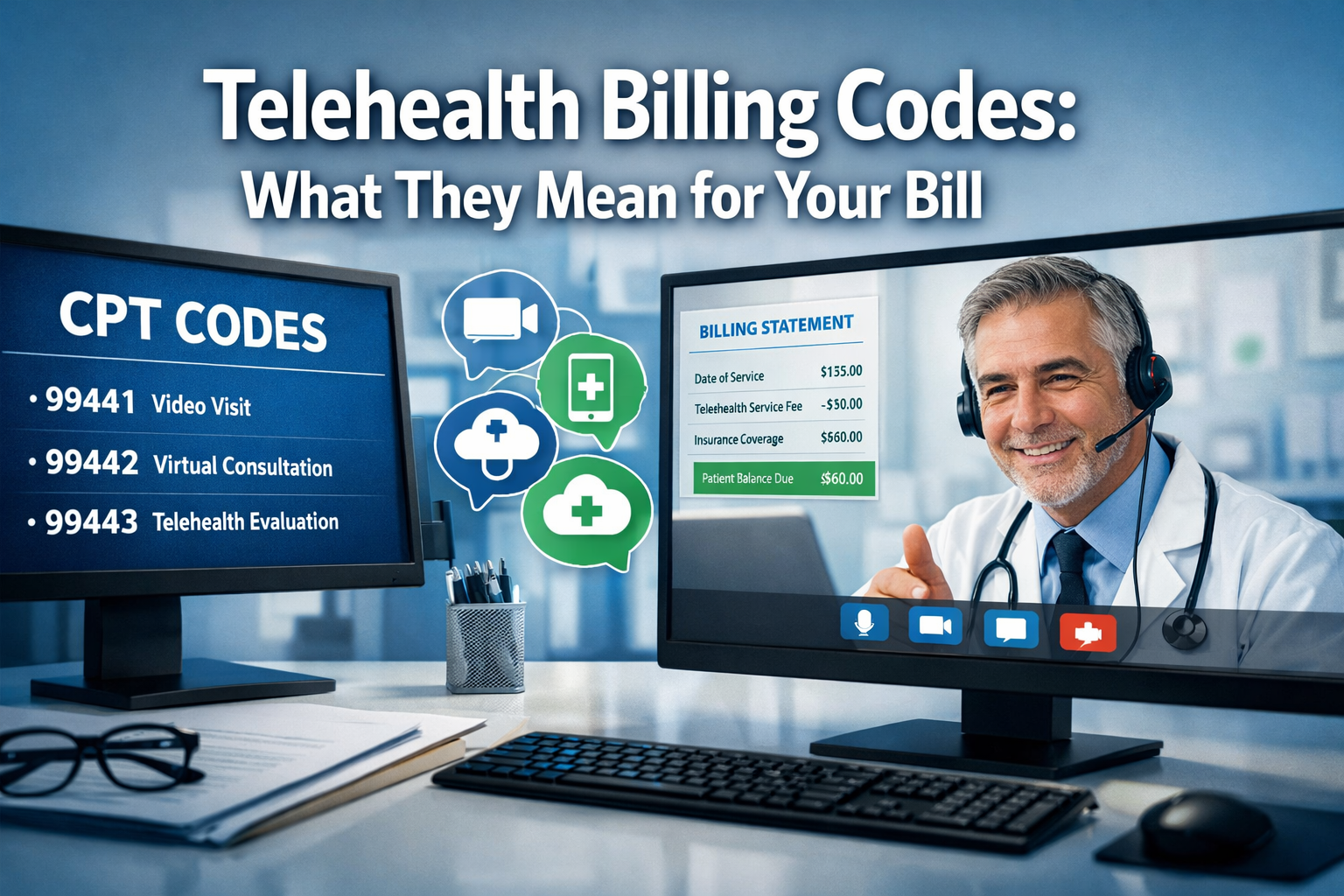
Telehealth billing codes are specific medical procedure codes that doctors use to bill insurance companies and patients for virtual healthcare services. These codes, including G2012 for virtual check-ins and 99421-99423 for digital consultations, directly affect what you pay for remote medical care. Understanding these codes helps you anticipate costs and verify accurate billing for telehealth appointments.
Key Takeaways
- Telehealth billing codes determine how much you pay for virtual medical appointments.
- Common codes include G2012 (virtual check-ins), 99421-99423 (digital consultations), and traditional office visit codes with modifier -95.
- Virtual visits often cost 10-30% less than in-person appointments using the same base codes.
- Insurance coverage varies significantly between different telehealth billing codes.
- The modifier -95 indicates services provided via telehealth technology.
- Some codes require established patient relationships, while others allow new patient consultations.
- Documentation requirements differ between telehealth and traditional billing codes.
What Are Telehealth Billing Codes and How Do They Work?
Telehealth billing codes are standardized numerical identifiers that healthcare providers use to describe and bill for medical services delivered remotely through video, phone, or digital platforms. These codes follow the same Current Procedural Terminology (CPT) system used for in-person visits but include specific modifiers and unique codes for virtual care.
The billing process works through three main code categories:
Traditional CPT codes with telehealth modifiers: Doctors use standard office visit codes (99213-99215) but add modifier -95 to indicate the service was provided via telehealth technology. This approach maintains billing parity with in-person visits.
Telehealth-specific G codes: Medicare and many insurers recognize special G codes like G2012 for brief virtual check-ins and G2010 for remote patient monitoring. These codes have different reimbursement rates and requirements.
Digital communication codes: Codes 99421-99423 cover asynchronous digital consultations where doctors respond to patient messages or review submitted information without real-time interaction.
Choose telehealth-specific codes if your appointment involves brief check-ins, remote monitoring, or message-based consultations. Use traditional codes with modifier -95 if you're having a standard consultation that happens to occur via video instead of in-person.
Common Telehealth Billing Codes and Their Costs
The most frequently used telehealth billing codes fall into several categories, each with different cost implications for patients.
Video consultation codes (99213-99215 with modifier -95):
- 99213-95: Established patient, low complexity ($75-120).
- 99214-95: Established patient, moderate complexity ($110-180).
- 99215-95: Established patient, high complexity ($150-250).
Virtual check-in codes:
- G2012: Brief virtual check-in (5-10 minutes) ($15-35).
- G2010: Remote patient monitoring setup ($40-75).
Digital consultation codes:
- 99421: Digital evaluation, 5-10 minutes ($15-30).
- 99422: Digital evaluation, 11-20 minutes ($25-50).
- 99423: Digital evaluation, 21+ minutes ($35-70).
Telephone consultation codes:
- 99441: Phone consultation, 5-10 minutes ($20-40).
- 99442: Phone consultation, 11-20 minutes ($35-65).
- 99443: Phone consultation, 21-30 minutes ($50-90).
Common mistake: Assuming all telehealth visits cost the same. Virtual check-ins (G2012) typically cost much less than full consultations, but they're limited to brief follow-ups for established patients.
How Telehealth Billing Codes Affect Your Insurance Coverage?

Insurance coverage for telehealth billing codes varies dramatically depending on your plan type, the specific code used, and your state's regulations.
Medicare coverage rules: Medicare covers most telehealth services using traditional CPT codes with modifier -95 at the same rate as in-person visits. However, G codes like G2012 have separate coverage criteria and may require copayments even if you've met your deductible.
Private insurance variations: Most commercial insurers cover telehealth consultations using codes 99213-99215 with modifier -95, but coverage for digital communication codes (99421-99423) remains inconsistent. Some plans exclude these entirely, while others cover them with higher copayments.
State-specific requirements: Many states mandate insurance parity for telehealth services, meaning insurers must cover virtual visits at the same rate as in-person care when using equivalent codes.
Coverage decision factors:
- Provider network status: Out-of-network telehealth visits may not be covered, regardless of the billing code.
- Medical necessity: Insurance may deny claims for routine check-ins using certain G codes.
- Documentation requirements: Some codes require specific documentation that affects approval rates.
Choose in-network providers if you want predictable coverage. Verify coverage in advance if your appointment uses G codes or digital consultation codes, as these have less consistent insurance acceptance.
Understanding Telehealth Billing Code Modifiers
Modifiers attached to telehealth billing codes provide crucial information that affects both reimbursement and patient costs.
Modifier -95 (Telehealth services): The most common telehealth modifier, -95, indicates that a standard medical service was provided via real-time audio and video technology. This modifier maintains billing equivalency with in-person visits for most insurers.
Modifier -GT (Telehealth via telecommunications): Used primarily for Medicare services, -GT indicates services provided through telecommunications systems. This modifier is being phased out in favor of -95 for most services.
Place of service codes: Telehealth visits use specific location codes (02 for telehealth provided in the patient's home, 10 for telehealth provided in the patient's home) that affect billing and coverage determinations.
Documentation requirements by modifier:
- Services with -95 require real-time audio-video interaction documentation.
- G codes may require consent documentation and established patient relationship verification.
- Digital consultation codes need timestamped communication records.
Edge case: Some rural health clinics use different modifier combinations that can affect patient responsibility amounts, even when using identical base codes.
What to Expect on Your Telehealth Bill?

Your telehealth bill will show specific telehealth billing codes that determine your financial responsibility and help you verify accurate charges.
Bill components you'll see:
- Primary procedure code: The main service code (99214, G2012, etc.).
- Modifier notation: Usually -95 or specific G code designation.
- Place of service: Typically coded as 02 (telehealth/patient home).
- Provider charges: The full amount before insurance adjustments.
- Insurance adjustments: Covered amounts and contractual reductions.
- Patient responsibility: Your copay, coinsurance, or deductible portion.
Verification steps:
- Match the code to your actual service: A 5-minute check-in shouldn't be billed as 99215 (high complexity visit).
- Confirm modifier usage: Video visits should show -95 modifier on traditional codes.
- Check place of service: Telehealth visits should not show office location codes (11).
- Verify time-based codes: Digital consultation codes should match the actual interaction time.
Red flags for billing errors:
- Multiple high-complexity codes (99215) for routine follow-ups.
- Missing telehealth modifiers on virtual visits.
- Charges for services not actually provided during your appointment.
Contact your provider's billing department if you see codes that don't match your actual appointment type or duration.
Conclusion
Understanding telehealth billing codes empowers you to anticipate costs, verify accurate billing, and make informed decisions about your virtual healthcare options. The key codes to remember include traditional office visit codes with modifier -95 for full consultations, G2012 for brief virtual check-ins, and 99421-99423 for digital communications.
Take these steps to manage your telehealth billing:
- Ask your provider which codes they plan to use before your appointment
- Verify your insurance coverage for specific telehealth codes
- Review all bills for accuracy and appropriate code usage
- Keep records of your appointment duration and services received for billing verification
As telehealth continues expanding in 2026, staying informed about billing codes helps you access convenient care while avoiding unexpected costs and billing errors.
FAQ
Do telehealth billing codes cost more than regular office visits?
No, most telehealth services using traditional codes with modifier -95 cost the same as in-person visits. Virtual check-ins (G2012) and digital consultations typically cost less than full office visits.
Will my insurance cover all telehealth billing codes?
Coverage varies by insurer and code type. Traditional codes with -95 modifiers have the best coverage, while G codes and digital consultation codes may have limited or no coverage depending on your plan.
Can doctors use any billing code for telehealth visits?
No, doctors must use appropriate codes based on the actual service provided, interaction type, and time spent. Misusing codes violates billing regulations and can affect your costs.
What's the difference between G2012 and 99214-95 codes?
G2012 covers brief virtual check-ins (5-10 minutes) for established patients, while 99214-95 represents a moderate complexity consultation that can be for new or established patients and typically lasts 20-30 minutes.
Do I need to pay up front for telehealth services?
Payment timing depends on your provider's policy and insurance coverage. Some require payment at the time of service, while others bill insurance first and send you a statement for remaining balances.
Can emergency telehealth visits use different billing codes?
Yes, urgent care telehealth visits may use higher-level codes (99215) or specific urgent care codes, which typically result in higher patient costs than routine consultations.
How do I know if my telehealth provider is billing correctly?
Review your explanation of benefits and compare the billed codes to your actual appointment. The code should match the complexity, duration, and type of service you received.
Are there telehealth billing codes for mental health services?
Yes, mental health providers use standard psychotherapy codes (90834, 90837) with telehealth modifiers, and these are widely covered by insurance when provided by licensed professionals.